When people talk about learning Chinese, the first image that usually pops up is an "impossible mountain"—tens of thousands of characters, complex strokes, and a feeling that you’ll never finish climbing.
But what if I told you that Chinese is actually the easiest language in terms of "Return on Investment" (ROI)? Believe it or not, according to the Modern Chinese Corpus and national language statistics, Chinese characters follow a massive "80/20 Rule." By mastering just a tiny core of characters, you can "hack" your way through the vast majority of reading obstacles.
The Magic of Character Counts: From 100 to 3,500
While there are tons of characters in existence, the ones that are actually "alive" in daily life are extremely concentrated. Check out this table—it’s about to flip your "Chinese is hard" mindset upside down:
| Characters (Cumulative) | Coverage Rate (Approx.) | Your Superpower / Real-World Usage |
|---|---|---|
| 100 | ~ 50% | The Lucky Start: You'll recognize 1 out of every 2 characters you see. |
| 300 | ~ 70% | Survival Mode: You can navigate menus, notes, and street signs. |
| 500 | ~ 80% | Basic Socializing: You get the "skeleton" of social media posts. |
| 1,000 | 90% - 92% | The Game Changer: You can start actually reading news and articles. |
| 2,000 | ~ 98% | Smooth Sailing: Novels and newspapers become accessible. |
| 3,500 | ~ 99.5% | The Cultural Boss: You've mastered almost everything in modern print. |
📊 Visualizing the "Hockey Stick" Curve
The relationship between characters and coverage is a logarithmic curve that shoots up and then levels off:
- The First 1,000: The curve shoots up almost vertically. Your learning efficiency is through the roof!
- 1,000 to 3,500: The curve stabilizes. You are now entering the deep reading phase.
- Beyond 3,500: The curve goes flat. Every new character adds almost nothing to daily reading ability.
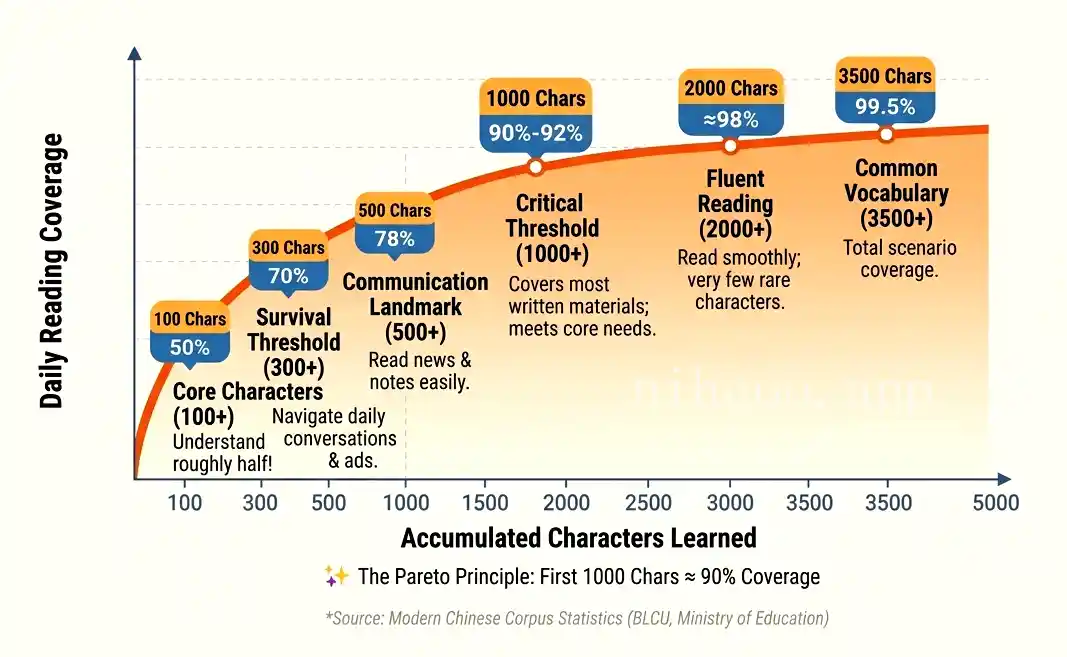
The learning curve: The first 1,000 characters provide 90% of the value.
Head-to-Head: Why Chinese is "Cheaper" than English or Spanish?
To cover 90% of a daily text, here is how much you need to memorize in different languages:
| Language | Amount Needed for 90% Coverage | Unit Type |
|---|---|---|
| Chinese | 1,000 | Characters |
| English | 3,000 - 4,000 | Words |
| Spanish/French | 4,000 - 5,000 | Words |
The logic is simple: Chinese characters are like high-density "Semantic Legos." As we explored in the 5,000-year evolution of Chinese characters, these symbols carry core meanings. By snapping 1,000 pieces together, you build tens of thousands of words.
Your Battle Plan: Breaking the Mountain into Steps
- Phase 1: The High-Frequency Sprint (Goal: 1,000 chars)
Focus on the top 1,000. Use learning characters through pictures to create visual shortcuts. - Phase 2: The Reading Breakthrough (Goal: 2,000 chars)
Unknown characters become rare. Treat Chinese like a mental math hack where knowing "A" and "B" helps you solve "AB." - Phase 3: Mastery & Knowing When to Quit (Goal: 3,500 chars)
3,500 is your ultimate destination.Quick Tip: nihaoo.app has integrated the top 3,500 essential characters. You can explore these 3,500 characters on nihaoo.app and customize your learning path.
💡 Pro-Tips for Learners
- Laser Focus: Learn 5 high-frequency characters a day, and you'll hit that 90% mark in just six months.
- Combination is King: The more characters you know, the easier it is to "guess" new words.
- Don't Overdo It: Once you hit 3,500, let the rest happen naturally through reading.
The Takeaway: Learning Chinese isn't a marathon through 90,000 symbols; it's a hike where the best view appears after the first 1,000 meters.
1. Statistics are based on the Modern Chinese Corpus.
2. Characters ≠ Words: You still need to learn how characters combine and follow grammar rules.
3. Comparison: Difficulty is subjective and depends on your background!